The Chungbuk Times > Culture > View
Meme Marketing: Advertisements Become Content
제 228 호 발행일 : 2026.06.01
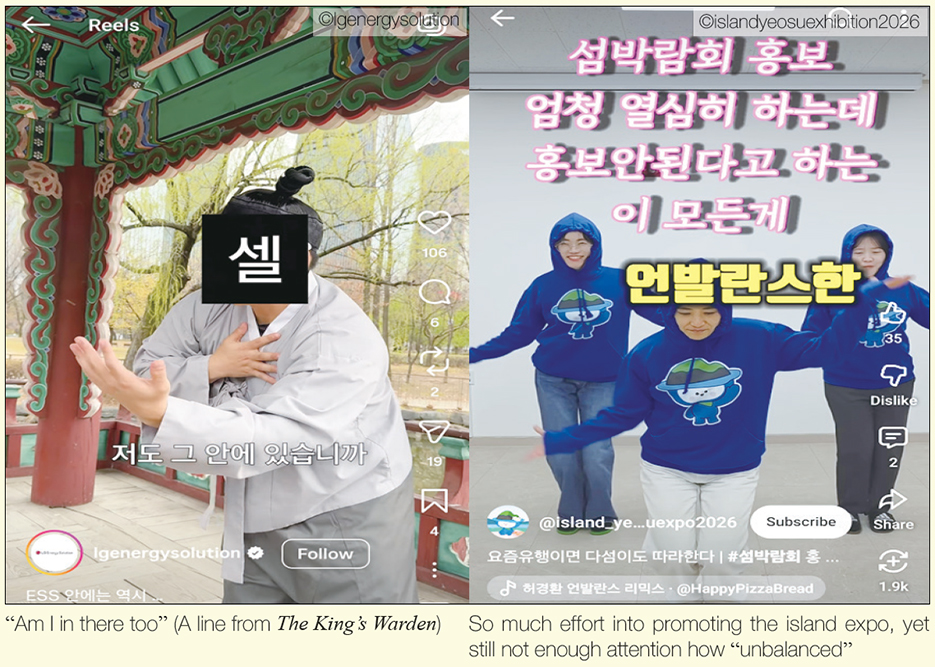
Meme is everywhere on social media. With just a brief scroll, users are likely to encounter them in their feeds. According to Forbes, millennials are estimated to encounter 20 to 30 memes per day. In Korea, several meme phrases have recently gained popularity, including “Doum manidoenda” which means “this is so helpful” is coined by a former MMA fighter—used to reframe hardship as a source of growth. “Unbalanced” which is popularized by a comdian—applied to situations that feel awkward or out of place. Parodies of scenes from the film The King’s Warden have also circulated online.
According to a report by marketing agency Amra & Elma, the global meme industry is projected to surpass 8.4 billion USD in 2026. Keeping pace with this trend, a growing number of companies have begun meme-based marketing.
Why Companies Are Choosing Meme Marketing
One reason companies are turning to meme marketing is that consumers are becoming increasingly skilled at avoiding conventional ads. According to a research team of Park Bok-jae and Kim Gil-sung (2024) from Major of Global Business at Chonnam National University, today’s people are exposed to a vast number of advertising channels as digital devices have become a part of everyday life. In this crowded media environment, ad avoidance has become increasingly widespread. Viewers switch channels when commercial films air on TV and skip YouTube ads as soon as the five-second threshold passes. For this reason, companies find it difficult to expect promotional returns proportionate to the high cost of ad production. The research explains that meme have emerged as an alternative to conventional advertising methods.
The key to meme marketing lies in the fact that consumers perceive it not as ads but as a content. Within a culture where consumers treat memes as entertainment to be shared, companies can insert brand messages in a less intrusive way. This reduces psychological resistance and encourages voluntary engagement. In this sense, meme marketing reflects companies’ attempts to adapt to the habits of today’s media users.
Mun Si-hyeon (Jincheon, 27), who regularly watches memes, said, “Meme ads do not feel like ads at all—they are just fun. They seem more effective than conventional advertising formats.” Alonso Rubio Vanessa (Dept. of Astronomy and Space Science, 25) said, “When I see something that I needed in a meme ad, I end up purchasing it. Meme ads seem very effective.”
Corporate Cases of Meme Marketing
Meme marketing strategies broadly fall into two types: directly producing meme-style promotional videos using a trending meme concept and incorporating memes into events.
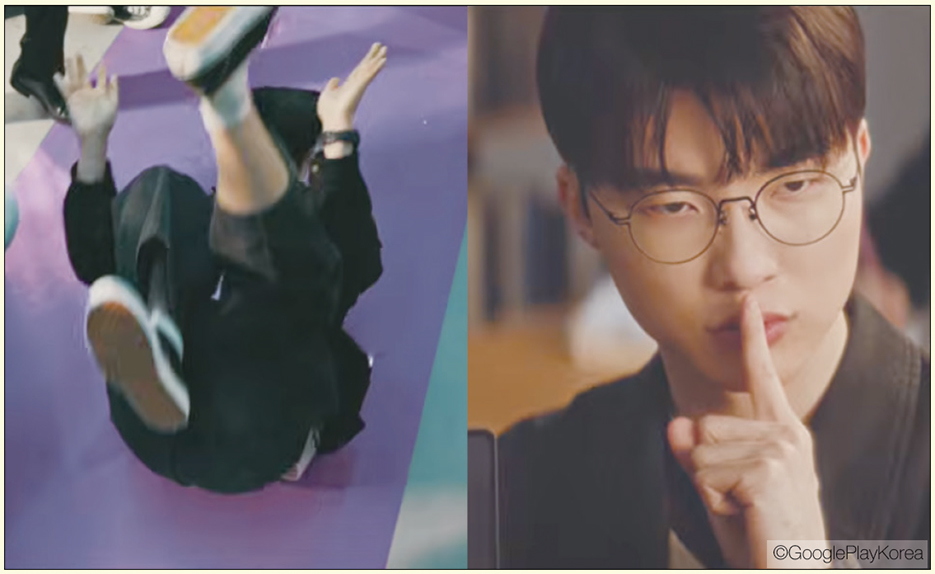
Google Play Korea recently released a meme ad associated with professional gamer Faker, accumulating 2.4 million views in just five days. The ad featured a charismatic “Shh...” pose—Faker silencing his opponents and the crowd with a look straight into the camera—along with a sudden flashy forward roll he performed while taking the stage, as well as the widespread “Faker worship” meme that has come to dominate online communities. Viewers responded with comments such as “Cannot believe they used this here,” “This is the first time I have ever searched for an ad on purpose,” and “I would pay to watch this.”
Olive Young held a blind product trial event for upcoming cream launch under the name “Bam tea cream”—a designed to resemble “Bamti”—a Korean slang term meaning “ugly” or “shabby.” By giving the product a deliberatel unusual name, the company encouraged curiosity and online discussion before the official product release. The campaign drew participation from consumers and generated user-created content.
Effective Strategies in Meme Marketing
According to Park and Kim (2024), three factors are especially important in meme marketing—timeliness, creativity, and interactivity. The study, which surveyed younger consumers including MZ generation, found that all three—responding to trends quickly, recreating content with fresh humor and entertainment, and encouraging two-way consumer participation and sharing—have a significant effect on enhancing brand and product image.
One example that reflects these factors is a Jim Beam ad featuring Jang Won-young of IVE and a actor Park Jeong-min. The ad drew significant attention with a phrase, “Won-young-style thinking,” which refers to Jang’s highly optimistic way of interpreting situations. It contrasted this with “Jeong-min-style thinking” which means blunt and pessimistic responses, creating a humorous exchange between the two figures. The ad has since garnered approximately 5.8 million views.
In the ad, Jang exclaims, “Jim Beam Highball with your favorite friends!” Park shoots back, “But I do not have any friends.” Jang fires back: “Even better—Jim Beam Highball alone at home, nice and calm!”
The ad secured timeliness by drawing on “Won-young-style thinking,” a phrase widely discussed online. It exercised creativity by pairing it with a character of the exact opposite disposition, generating a fresh dynamic. Furthermore, Jim Beam broke from the conventional single-brand advertising framework by launching an unprecedented joint campaign integrating 9 brands that share Jang as a model. The campaign also released a long-form video (3 minutes 42 seconds) directed by Dolphiners Films on YouTube ahead of the broadcast rollout, giving consumers a digital space to engage with the content and share reactions in the comments—rather than passively watching a 15 seconds TV spot—thereby securing two-way interactivity.

Meme marketing has emerged as one of the most effective strategies for reaching consumers who increasingly avoid conventional ads. Going beyond a one-time laugh, meme marketing, which drives audiences to voluntarily seek out and share ads, can help brands raise awareness and build a more approachable image. It remains to be seen what creative memes will emerge next to capture the public’s attention once more.
By Bae Young-jun
hangeul1399@chungbuk.ac.kr