The Chungbuk Times > Feature > View
The Science behind Caffeine and Wise Ways to Consume It
제 228 호 발행일 : 2026.06.01
During exam periods, coffee cups and energy drink cans are a common sight on the desks of libraries. To overcome academic stress and insufficient sleep while maintaining concentration, many students rely on caffeine.
However, how does the caffeine students mindlessly consume every day actually operate within our bodies, and what effects can it have beyond temporary alertness? Based on the actual experiences of CBNU students, insights from a specialist, and finding from research papers published in international academic journals, a CBT reporter has delved deeply into a mechanism of caffeine and ways to consume it safely and wisely.

The Daily Life of Students and Caffeine: A Necessity to Forget Fatigue
For many students, starting the day with an iced Americano has become a routine, and energy drinks often help them get through all-night study sessions during exam periods. Caffeine has already established itself deeply within the daily lives of students. Kim Tae-bin (Dept. of Manufacturing Pharmacy, 23) smiled and said, “When I was younger, I could not understand why people consumed coffee that tastes bitter, but at some point, my day started to feel incomplete without Americano.” In particular, during exam periods, her caffeine intake increases even further. She honestly confessed, “During exam periods, I study for longer hours, I usually drink up to two or three cups of coffee a day,” adding, “Rather than feeling a clear increase in alertness, I think there is also a placebo effect, ‘Since I drank coffee, I should not doze off.’”
Conversely, there are cases where individuals stopped consumption due to the side effects of caffeine. Park Seong-eun (Dept. of Manufacturing Pharmacy, 23) stated, “Until last year, I drank coffee every single day, at least one cup a day, but after experiencing side effects, I try not to drink it.” She added, “When I drank two to three cups of coffee more than usual during an exam periods, I experienced severe symptoms similar to a panic disorder, where my chest felt tight and it was difficult to breathe properly,” and noted, “Since I quit drinking coffee, those symptoms have completely disappeared.” This suggests that the impact of caffeine on the body can vary greatly depending on the individual.
The Mechanism of Action of Caffeine: The War against Adenosine Receptors
The most common function of caffeine is to reduce drowsiness and increase alertness. Then, how does it work?
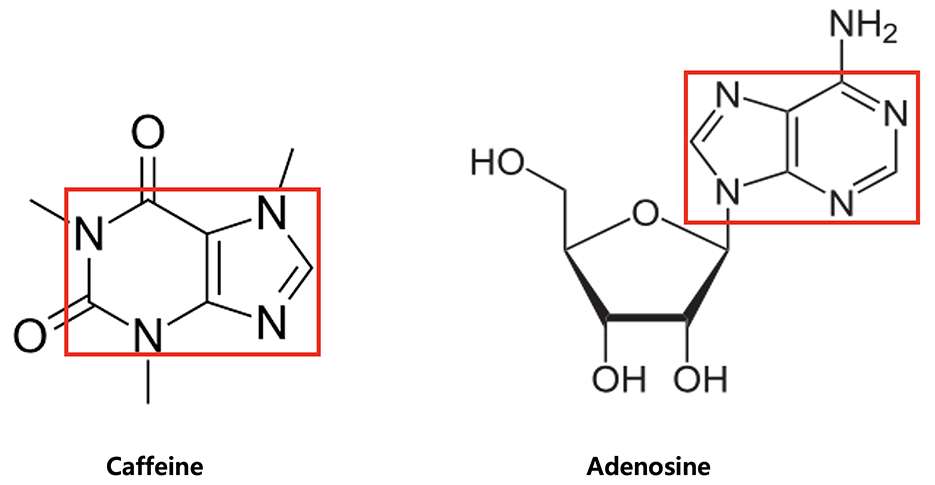
To understand the action of caffeine, it is necessary to first understand a substance called adenosine. Adenosine is the substance generated and gradually accumulated within the brain during waking activities. When this substance binds with adenosine receptors (A₁, A₂A), it slows down certain neural activity, causing one to feel fatigue and become sleepy. The longer one stays awake, the more adenosine accumulates to signal the time to sleep, thereby protecting the body from overwork.
The molecular structure of caffeine is similar enough to adenosine. For this reason, caffeine acts as a “competitive antagonist” that binds to the receptors first instead of adenosine. When caffeine occupies the receptors before adenosine, adenosine cannot fully deliver its sleep-promoting signal. As a result, the brain does not receive the signal that fatigue has accumulated and drowsiness is temporarily reduced. In other words, after consuming caffeine, the body is merely in a state where the signal is blocked so that the brain cannot feel fatigue, but the fatigue itself has not disappeared.
Tolerance and Dependence of Caffeine
At first, one could stay up all night with just a single cup of coffee, but as time passes, many experience their intake increasing to two or three cups. This is due to caffeine tolerance. When caffeine is consumed over a long period, our body generates an adaptive response.
According to a research team of Ribeiro and Sebastião (2010), in the case of chronic caffeine consumption, the brain triggers an Up-Regulation phenomenon that increases the number of adenosine receptors to compensate for the blocked adenosine signals. As the number of receptors increase, the existing amount of caffeine can no longer block enough receptors, leading to the development of tolerance where one does not feel the same arousal effect as before and seeks a larger amount.
Professor Yoon Jae-seok of the College of Pharmacy at CBNU explained, “People who habitually and excessively consume caffeine greatly exceed the daily caffeine intake of an average adult (200mg to 400mg),” adding, “This phenomenon is closely related to the functional regulation and tolerance of adenosine receptors.” Fortunately, caffeine tolerance is not necessarily permanent. Prof. Yoon added, “If one stops caffeine consumption, adenosine receptors normalize, and tolerance can also be suppressed.”
However, Prof. Yoon warned that regular caffeine use can lead to dependence-like symptoms in some people. He pointed out, “If a person who regularly consumed caffeine experiences mental and physical withdrawal symptoms such as headaches, lethargy, and fatigue when quitting coffee, caffeine dependence should be considered.”
Caffeine Side Effects: Nervousness, Gastrointestinal Disorders, Insomnia, etc.
Experiencing side effects instead of the expected arousal from caffeine is common. Park reported breathing difficulties, while Kim noted brief dizziness and blurred peripheral vision after drinking coffee. Lee Han-na (Dept. of Nursing, 23) added that coffee often causes her heartburn and stomachache, making her cautious.
Regarding this, Prof. Yoon warned, “Chronically consuming an excessive amount of caffeine of over 1,000mg per day can cause caffeine intoxication syndrome, which is accompanied by gastrointestinal disorders, nervousness, insomnia, and tachycardia (fast pulse).” He also urged caution, stating, “The benefits and harms of caffeine depend on the regular intake amount,” and noted, “Frequent headaches have been reported in children and adolescents who drink at least 1.5 liters of cola (containing approximately 200mg of caffeine) per day.”
The deterioration of sleep quality is also a serious problem. Park complained, “On days I drink coffee, even if I sleep for a long time, I do not feel refreshed in the morning.” In fact, according to findings of Reichert, Deboer, and Landolt (2022), when caffeine is consumed immediately before bedtime, sleep latency, which means the time it takes to fall asleep, lengthens, and overall sleep efficiency decreases.
Enhancement of Cognitive Function or Simple Arousal?
Some students seek caffeine to increase study efficiency and memory. Lee said, “When I drink coffee, I get the feeling that I can concentrate well, so I drink it during exam periods even when I experience side effects.”
To this, Prof. Yoon explained, “There are reports that the neurochemical action of caffeine reverses drowsiness and lethargy caused by lack of sleep, and improves the fatigue performance capability of drivers.” He added, “There is an effect of improving working memory or attentiveness in the short term, such as alertness and concentration significantly increasing when a low or moderate dose of caffeine is consumed.”
Energy Drinks vs. Pure Coffee: Which Is Safer?

High-caffeine beverages favored by students include energy drinks in addition to coffee. Energy drinks often contain other ingredients, including taurine, sugar, and vitamins in addition to caffeine.
Regarding this, Prof. Yoon warned, “According to overseas research, it has been reported that the excessive consumption of tonic beverages (energy drinks) containing sugar, taurine, and other components can pose serious health risks. Also, similar symptoms can appear when other high-caffeine foods are chronically consumed.”
On the other hand, positive effects were confirmed for pure coffee when consumed in moderate amounts. According to a large-scale cohort study in which a research team of Loftfield (2018) analyzed data from approximately 500,000 individuals in the UK Biobank, moderate consumption of pure coffee was found to be associated with a reduction in mortality rates and the risk of cardiovascular diseases. The research team analyzed that antioxidant substances such as polyphenols in coffee, exert beneficial effects on the body.
Methods for Wise Caffeine Consumption
Caffeine can act as either a helpful stimulant or a harmful substance depending on how, when, and how much it is consumed. The guidelines for wise caffeine consumption, based on expert recommendations, are as follows.
First, it is desirable to maintain the daily caffeine intake below 400mg for adults. Considering that one cup of Americano contains approximately 125mg of caffeine, two to three cups a day may be considered an appropriate limit.
Second, caffeine consumption should be avoided late in the afternoon, especially within 6 hours before bedtime. The half-life of caffeine is approximately 5 to 6 hours, meaning coffee consumed in the evening can degrade the quality of night sleep.
Third, when the exam period ends, it is recommended to stop caffeine consumption for a certain period of time to reset tolerance. Furthermore, rather than repeatedly relying on caffeine every day, utilizing it strategically at necessary moments is a method to reduce tolerance.
Fourth, if one reacts sensitively to caffeine or exhibits side effects such as anxiety, sleep disorders, and gastrointestinal problems, considering reducing the intake amount or quitting caffeinated beverages is necessary.
Caffeine continues to awaken the days of many students. Understanding the scientific principles behind a single cup of coffee may help them manage their caffeine consumption more wisely.
By Ko Ga-ryoung
ifsuc33@chungbuk.ac.kr