

 최종편집 : 2026.09.07 월 19:58
  All
All Culture


 Park Yong-bin

Recently, the Dubai Chewy Cookie, also known as Duchonku, has been rapidly spreading on social media in a short period of time. Its exotic name, rich pistachio green color, and crispy and chewy texture have excited consumers’ curiosity, dominating various social media platforms. Just a few months ago, this dessert was relatively unknown, but it has now become a trendy dessert that people line up to eat, and it has expanded beyond cafes to be sold in various restaurants, leading to this exceptional phenomenon.
Therefore, why is it called Dubai and chewy cookie? A CBT reporter takes a deep dive into the origins of Duchonku, its preparation method, and through on-site interviews, explores how this dessert became a trend.
The Beginning of Duchonku
Duchonku is not simply a dessert that was imported from Dubai to Korea. Rather, it is a unique trend-based dessert developed by the Korean food and beverage industry, inspired by the Arabic dessert, Dubai chocolate. By incorporating key ingredients such as kadayif and pistachios, which are used in the original Dubai chocolate, it earned the name, Dubai.
Duchonku, an evolved version of the traditional chewy cookie made with marshmallows and other ingredients such as crushed Oreos, highlights the harmony of kadayif and pistachio wrapped in marshmallow. The marshmallow that envelops the pistachios and kadayif gives a chewy texture at first before delivering a crispy mouthfeel. The unique contrast between chewiness and crispiness, along with the deep green visual appeal, created significant buzz. As many celebrities posted their photos on social media, public interest spread rapidly.
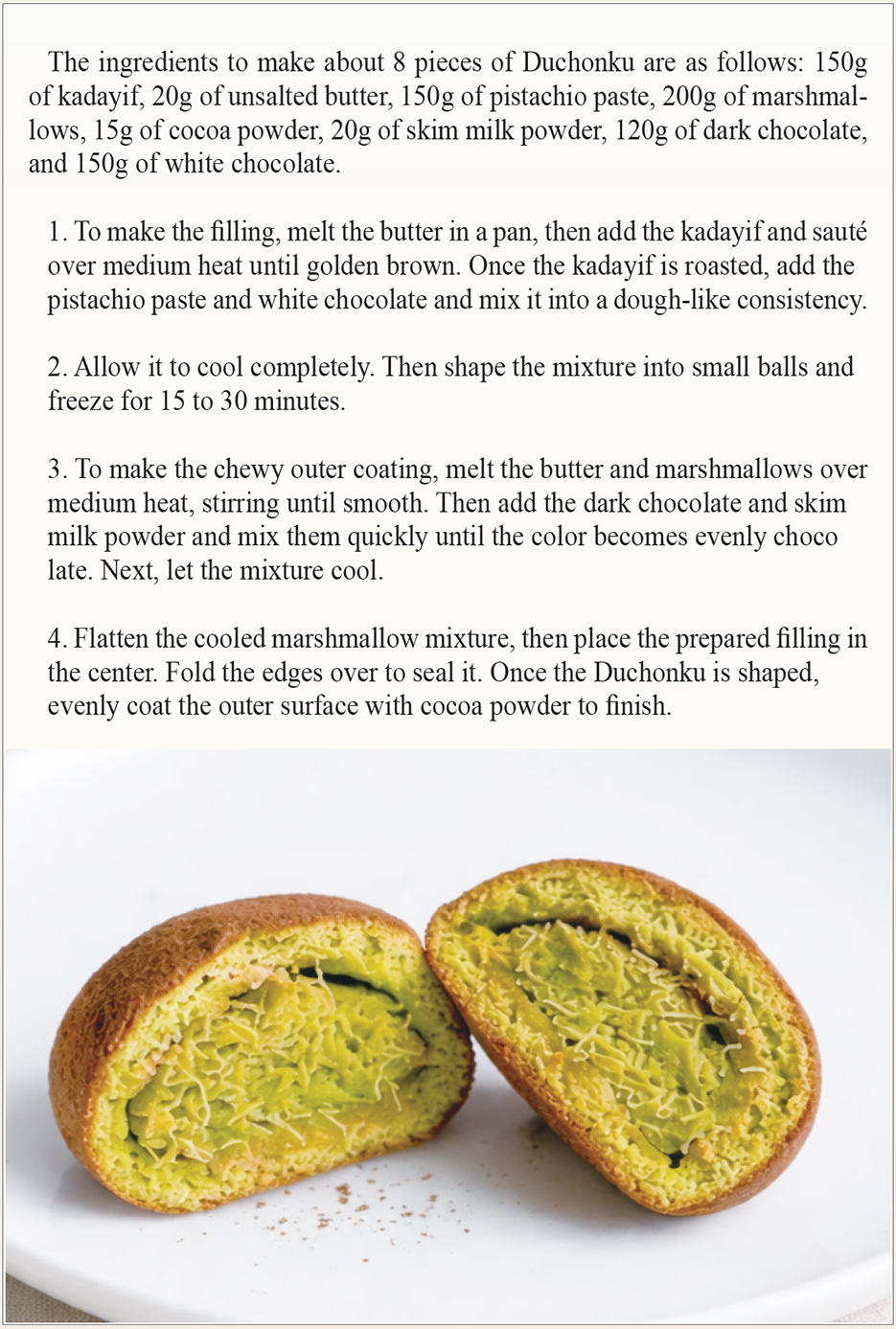
Ingredients and Recipe for Duchonku
Duchonku is a dessert that can be made without any special equipment, making it relatively easy to prepare at home. This article introduces a home baking recipe that can be easily followed.
The Controversy over the Price of Duchonku
Many consumers have probably wondered why Duchonku is priced so high. With an average price of 6,000 KRW per cookie, and sometimes as much as 10,000 KRW, consumers often attribute this to a premium. However, this is only part of the story.
As the popularity of Duchonku has risen, the prices of its main ingredients, pistachios and kadayif, have sharply increased. These raw materials are not produced domestically and entirely relied on imports, which have led to a limited supply. While demand has rapidly grown, the supply has not kept pace, causing a significant rise in ingredient prices.
For example, based on the price trend of pistachios sold on Coupang, it was around 18,000 KRW per 400g before the trend. By Jan. 2026, it had sharply increased to around 34,000 KRW to 40,000 KRW. Higher raw-material costs add up, and the consumer price of Duchonku has been set high, reinforcing the perception that the cookie is overpriced.
Duchonku Seen On-Site
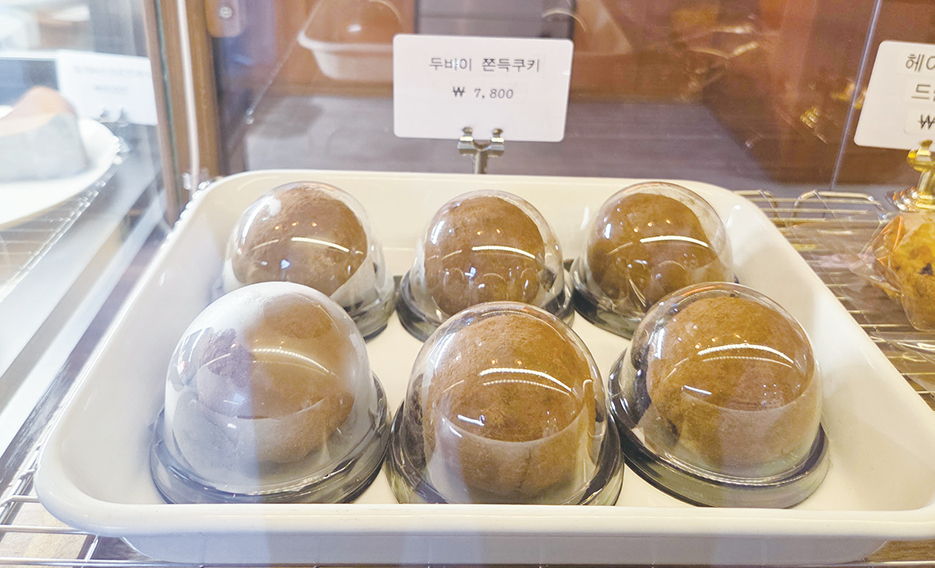
Cafe MOTO, located at the main gate of CBNU, is one of the few cafes in the area that sells Duchonku. The owner of Cafe MOTO, Jeong Hyeong-eun, mentioned that the cafe decided to sell Duchonku as more customers began asking for it. Jeong said, “Most of the customers who order Duchonku are in their 20s, but we also see some consumers in their 30s and 40s. The trend is expanding beyond the younger generation to include middle-aged and older consumers.”
Jeong said, “The price was set in consideration of labor and raw material costs.” She added, “The burden is heavy because the raw material prices keep rising every time we purchase them.” She continued, “Although many consumers are looking for Duchonku, it is unfortunate that we are unable to meet customer demand due to ingredient shortages, which make it difficult to ensure a stable supply.”
Lastly, Jeong added, “Compared to a few months ago, the number of consumers looking for Duchonku has noticeably decreased. I think there is a strong possibility that it is just a short-lived trend.” She expressed her skeptical view about whether the Duchoku craze will last.
Then how do consumers view the Duchonku trend? Kim Ye-rim (Taean, 29) said about the Duchonku trend, “I first learned about it through Instagram. Since Duchonku is relatively easy to make at home, many people shared the making process on Instagram, and I think that is why its popularity surged.” She continued, “I believe social media is the key factor driving the Duchonku trend.”
Additionally, Kim said, “People seem to like the unique texture created by using a new ingredient called kadayif. The cute-sounding name of Duchonku, a shortened form of Dubai Chewy Cookie, also seems to make the dessert feel more familiar.”
Kim also expressed some dissatisfaction with Duchonku. She said, “While I like the new texture and sweet taste, I am unhappy that the price feels too high for its size. It is also disappointing that it is not easy to find in stores.”
Duchonku has become a powerful trend in a short period, driven by its exotic image, unique texture, and the spread through social media. However, the high selling price ₋ often attributed to rising raw material costs ₋ along with unstable supply and consumer complaints, appears to be revealing the limitations of the trend. Recently, this craze seems to cool down as well. Whether Duchonku will continue as an ongoing trend or fade away as a mere passing craze remains uncertain.
By Park Yong-bin
2021014006@chungbuk.ac.kr


 Quick News