

 최종편집 : 2026.10.19 월 17:57
  All
All Campus News


 Lee Seo-young
The 58th Student Council election has come to an end. According to the results of the vote held from 9 a.m. on Nov. 25 to 6 p.m. on Nov. 27, the slate “PRO” was elected with 4097 votes (63.17%) and a turnout of 52.9%. PRO, short for People Right Organization, ran with the aim of listening to and representing students’ voices at the forefront. It presented major pledges such as establishing links between students and corporations or institutions, planning new student-oriented content, and introducing a participatory presidential election system for the practical benefit of students.
However, from the candidacy process to the moment its victory was confirmed, the PRO slate was at the center of ongoing controversy. The CBT has summarized the information received through reports and the responses provided by the PRO slate and the CBNU’s central election commission.
Controversy over Alleged Far-Right Rally Organizer on Campus Amid Impeachment Turmoil
On March 11, during simultaneous pro and anti impeachment rallies held on campus, an outsider entered the scene and used violent language and behavior toward students participating in the impeachment-support rally. The incident was treated as a serious act of violence targeting CBNU students, and some affected students later reported experiencing psychological distress, and related investigations and legal proceedings are still ongoing.
On Nov. 7 at around 7 p.m., the CBT received an email from an anonymous informant who identified themselves as a CBNU graduate. The email was titled “Reporting the Student Council Candidate, Organizer of a Far-Right Campus Rally Involving Violence and Arson.” The informant forwarded a News1 article, titled “Ahn Cheol-soo Meets the 2030 Generation, Vows to Devote Himself to Building a Happy Nation for the Future Generation” (April 20, 2025) mentioning, “Moon, a CBNU student who led a rally opposing the impeachment of former President Yoon Suk-yeol,” and raised allegations that PRO slate’s main candidate Moon Byung-ju (Dept. of Chemical Engineering, 23) was the organizer of the on-campus anti-impeachment rally on March 11 and tacitly supported or condoned the violent incident perpetrated by the outsider. Allegations of similar nature quickly spread during the policy debate on Nov. 19 and across platforms such as Everytime. However, the News1 article alone was insufficient to confirm these allegations as fact.
Accordingly, the CBT met with candidate Moon at 8 p.m. on Nov. 22 and asked, “We would like you to clarify the facts regarding the political-orientation controversy raised during the recent policy debate and on Everytime, as well as the allegation that you organized an on-campus rally opposing the impeachment of former President Yoon Suk-yeol.” Moon replied, “Some parts of the political-orientation controversy are inaccurate, and more importantly, there is no logical connection between running for the student council and holding a specific ideological stance,” adding, “If elected, I intend to compile the entirety of the political-orientation controversy into a timeline and publicly share it as a document to provide transparent explanations.”
The commission chose not to proceed with Moon’s response to the related questions during the policy debate, saying, “This is not appropriate for the setting of a policy debate, and the candidate qualification review has already been fully completed by the commission.”
Controversy over Central Club-Related Pledges Made without Prior Consultation
The PRO slate’s club-related pledges, included in its promotional pamphlet, also drew controversy. On the final page of the pamphlet, tailored pledges were listed alongside the names of 40 out of the 52 central clubs at the university. However, some of the pledge details had not been discussed in advance with certain clubs, prompting their presidents to raise objections and request corrections and an apology. It was also pointed out that only 40 clubs were included in the pledges, rather than all central clubs.
In response to these concerns, Moon promised through the KakaoTalk group chat of the central club presidents prior to the policy debate that he would officially apologize and make corrections regarding this issue during the debate. However, this promise was not kept. At the policy debate held on Nov. 19, club presidents questioned Moon, demanding ▲corrections to the club-related pledges ▲an explanation of the sources of the pledge materials ▲measures to address the issue, and ▲an official apology. Moon stated that after the debate, he would personally approach the club presidents present at the venue to apologize individually.
On Nov. 21, the PRO slate posted an apology message in the KakaoTalk group chat of the central club presidents and promised to upload the same apology to its social media account by Nov. 24. At the same time, it informed them that posting the apology required approval from the commission, which might cause delays.
In a Nov. 22 interview with the CBT, Moon addressed the issue and said, “I offer my official apology. Moving forward, we plan to gather each club’s circumstances and needs through discussions with the student club union and to concretize the pledges. We will also strengthen cross-verification with the club presidents in order to establish more accurate operational plans.”
However, as of the end of the campaign period, CBT was unable to confirm that an official apology from the PRO slate had been posted on its official channel.
Chae Seo-byung (Dept. of Physics, 23), president of the central club DIY DIY, remarked, “The fact that Moon avoids presenting a comprehensive solution to the issue is itself problematic. It sets a bad precedent. If a student council candidate can independently announce pledges without prior consultation with other student self-governing organizations on campus, and then gloss over the issue with an informal apology, future candidates may also believe they can propose pledges without sufficient review or consultation simply to win elections, disregarding existing student organizations. I think this issue must be addressed strictly in accordance with principles and procedure.”
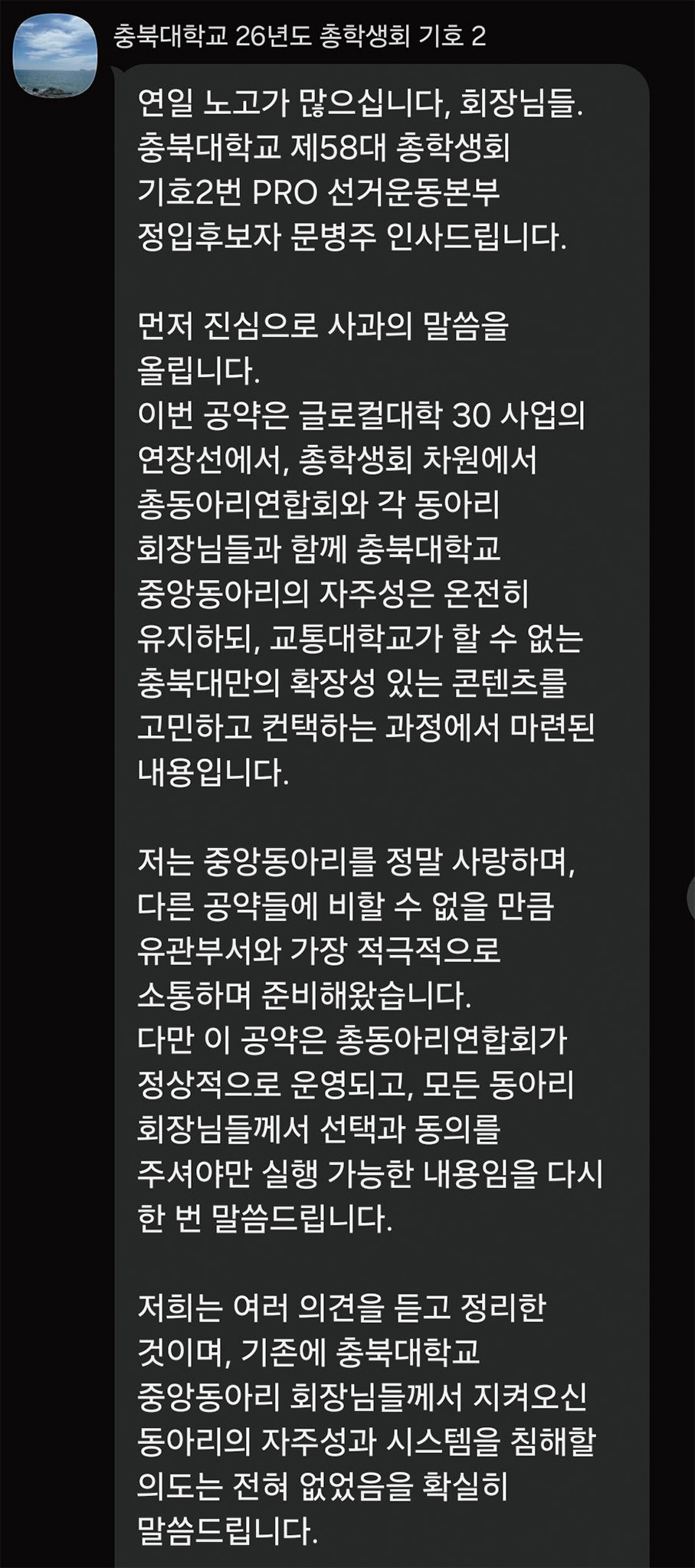
This message means,
“Moon Byung-ju: Hello presidents,
This is Moon Byung-ju, the presidential candidate of the 58th Student Council slate ‘PRO’ for the 2026 CBNU election.
First of all, I sincerely offer my apology.
This pledge was prepared as an extension of the Glocal 30 project. It was drafted through discussions with the Student Club Union and the presidents of each club at the student council level, with the intention of fully preserving the autonomy of CBNU’s central clubs while considering and exploring content with potential for growth that only CBNU—not KNUT—can create.
I truly care about the central clubs, and I have communicated with the relevant departments more actively than for any other pledge in preparation for this. However, I want to emphasize once again that this pledge can only be implemented when the Student Club Union is operating normally and when all club presidents make a collective decision and give their consent.
We have organized our thoughts after hearing various opinions, and I want to clearly state that we had no intention of infringing upon the autonomy or systems that the central club presidents of CBNU have maintained thus far.”
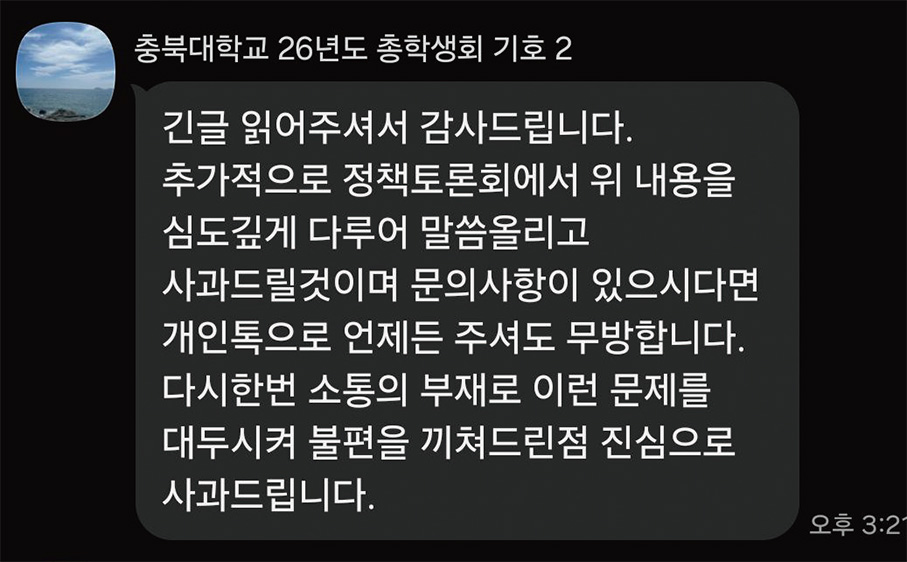
This message means,
“Moon Byung-ju: Thank you for taking the time to read this long message.
Additionally, I will address these matters in greater depth and offer my apology once again during the upcoming policy debate. If you have any questions, please feel free to contact me individually at any time.
Once again, I sincerely apologize for causing inconvenience due to the lack of communication.”
Allegations of Illegal Campaigning
On Nov. 26, Chungcheong Review published an article titled “CBNU 58th Student Council Election: Allegations of Illegal ‘Hospitality and Pre-election Campaigning’ by the A Slate.” Following this report, The CBT interviewed the individual who had initially provided the tip to confirm the details.
According to the whistleblower, at around 9:40 p.m. on Nov. 16, they witnessed members of the PRO slate putting up campaign banners near the Humanities and Social Science Hall (N14) and the College of Business (N13). “A friend of mine, who was a leave-of-absence student at the time, was in the vehicle transporting the banners. I did not take photos because I was concerned about possible legal issues, but several people heard him say he was helping the PRO slate,” the source testified.
In response to these allegations, the commission stated that the case did not provide sufficient grounds for disciplinary measures, citing three reasons:
1.The difficulty of verifying a student’s leave-of-absence status,
2.The absence of clauses regulating assistance from non-official campaign staff prior to the official campaign period
3.The interpretation that hanging banners before the campaign period does not constitute “electioneering,” which requires direct voter engagement.
While the 2026 Election Bylaws contain no provisions regarding campaigning by leave-of-absence students, there is precedent for sanctions. In the 2021 election, the CROSS slate, which served as the student council that year,, received disciplinary action after non-staff individuals were found to be involved in campaign activities.
The whistleblower also provided videos showing PRO’s three-dimensional promotional material displayed inside the first-floor lobby of the 1st Student Union Building at around 8:30 p.m. on Nov. 20. According to the 2026 Student Election Guidebook distributed by the commission, campaign activities must end at 8 p.m. each day, with all materials removed or stored by that time.
In response, the commission stated that the bylaws did not clearly address this situation and that opinions among the commission members were divided. As a result, the committee invoked Article 29 of Chapter 11—allowing decisions to be made by majority vote when issues are not covered in the bylaws—and announced that a vote would be held. However, the commission has not disclosed the outcome of that vote or whether any action was taken.
Notably, Article 15 of the bylaw states that “failure to comply with directives issued by the Central Election Commission” constitutes a violation. Some have argued that if the guidebook is interpreted as an official directive, the late-night display of campaign materials may fall under this prohibition.
Allegations of Pre-election Campaigning and Providing Hospitality
A second whistleblower—who had access to a group chat including candidate Moon and the student council president from the College of Agriculture, Life & Environment Sciences—provided screenshots raising additional concerns. The messages indicated that “the prospective presidential and vice-presidential candidates wish to host a meal for the presidents to facilitate communication.” Such wording could be interpreted as both pre-election campaigning and the provision of improper hospitality.
The commission acknowledged the meeting took place but responded with several clarifications:
1.Under the bylaws, pre-election campaigning is defined as campaigning outside the officially announced campaign period, but the meeting occurred before candidacy registrations were approved.
2.The bylaws primarily regulate candidates after they are officially recognized, making it difficult to apply them retroactively.
3.Although PRO’s prospective slate did indeed pay for the meal, the commission found no evidence of alcohol, entertainment, or explicit vote solicitation.
The commission concluded, “Considering all circumstances, parts of the meeting may be viewed as inappropriate. However, the evidence is not enough to be considered as the violation that involves official warning or disciplinary action under the current bylaws.”
The information above is based on materials submitted to the CBT and interviews conducted with multiple informants. Clear divergences in perspectives exist among the accounts provided by whistleblowers, the elected PRO slate, and the commission. It is now up to the students of CBNU to assess these issues fairly and to demand transparency where it is due.
By Lee Seo-young | seoyeongi619@chungbuk.ac.kr
By Lee Soo-jin | 100456su@chungbuk.ac.kr
By Gwon Ryeong-min | Dinosaurmin@chungbuk.ac.kr
By Park Ryeo-won | 2024078018@chungbuk.ac.kr
By Kim Ga-hee | gimg11393@chungbuk.ac.kr
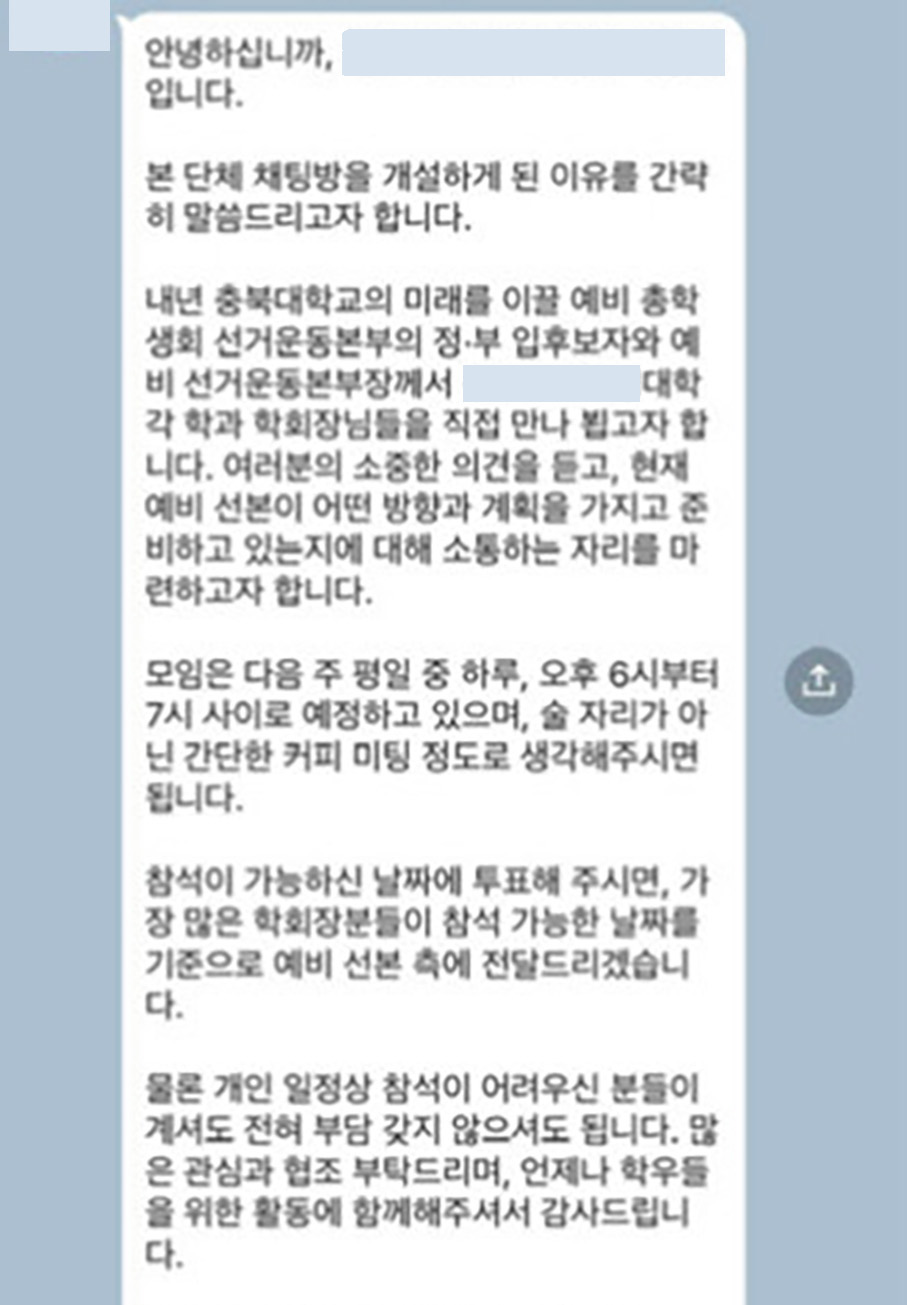
This message means,
“a department president in College A: I would like to briefly explain the reason for creating this group chat.
The preliminary Student Council election slate, which will lead the future of CBNU next year, wishes for the presidential candidate and the preliminary campaign manager to meet the presidents of each department in College A in person. We hope to hear your valuable opinions and create an opportunity to share and communicate the direction and plans that the preliminary slate is currently preparing.
The meeting is planned for one weekday next week, between 6 p.m. and 7 p.m., and you may think of it as a simple coffee meeting rather than a gathering involving alcohol. If you could vote for the dates you are able to attend, we will relay the date on which the largest number of department presidents can participate to the preliminary slate.
Of course, please do not feel pressured if you are unable to attend due to personal schedules.
We appreciate your interest and cooperation, and thank you as always for your dedication to serving our fellow students.”
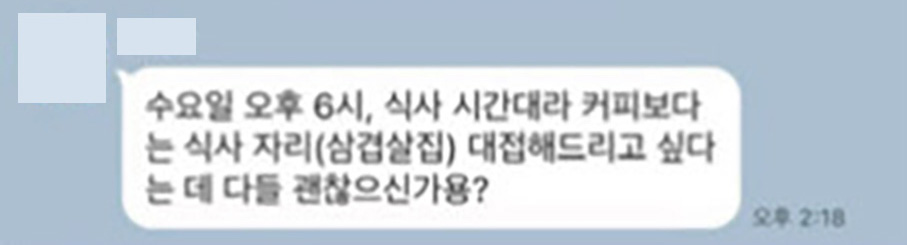
This message means,
“a department president in College A: Since Wednesday at 6 p.m. falls during dinner time, they would like to treat everyone to a meal (at a samgyeopsal place) rather than just coffee. Would that be alright with you all?”
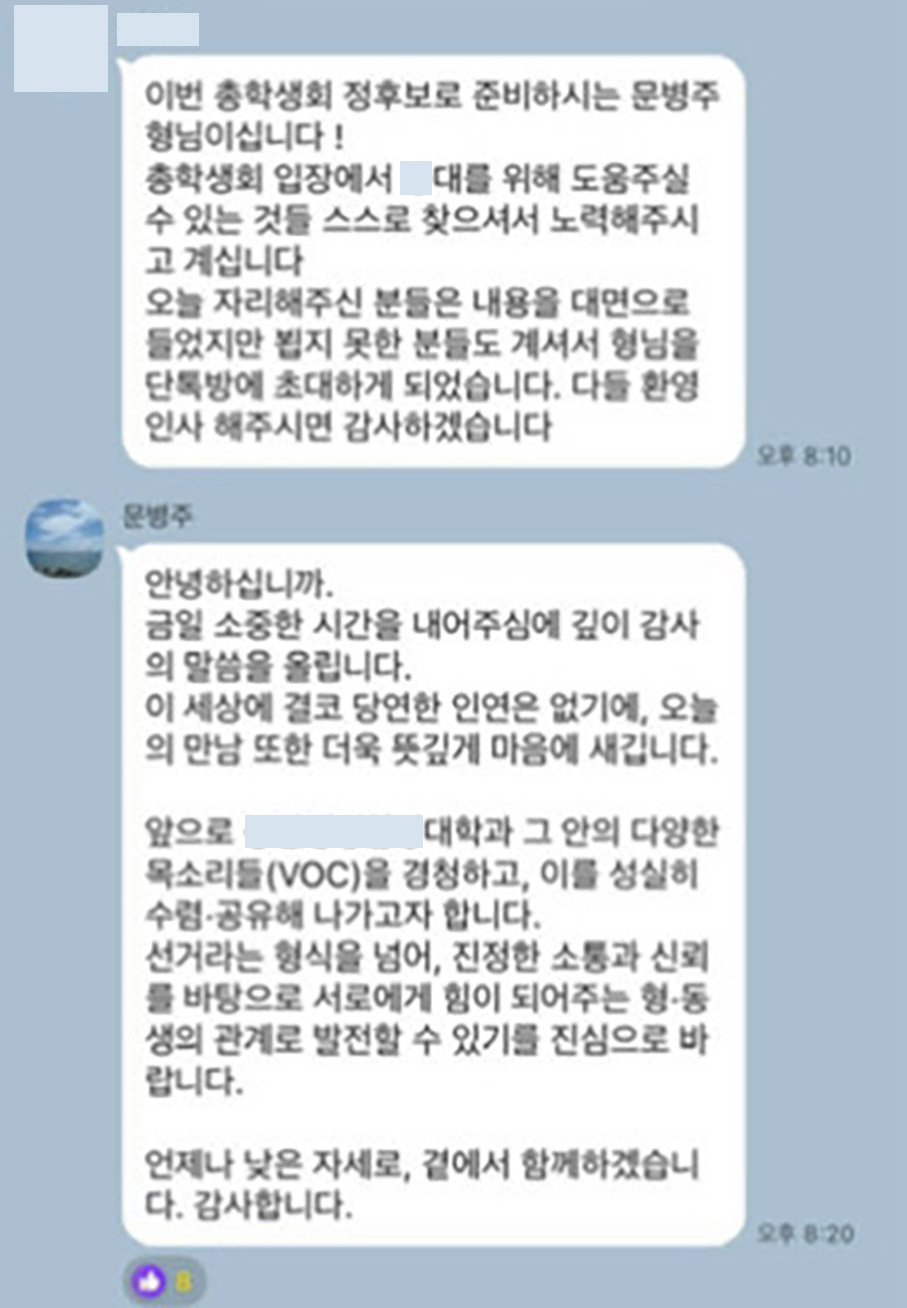
This message means,
“a department president in College A: This is Moon Byung-ju, who is preparing to run as the main candidate for the upcoming Student Council election. He has been proactively identifying ways he can support College A from the Student Council’s perspective and has been working hard on them.
Those who attended today’s meeting were able to hear this in person, but since some were unable to join, we have invited him to this group chat as well.
I would appreciate it if everyone could give him a welcome.”
“Moon Byung-ju: Good evening. I would like to express my sincere gratitude for taking the time to be here today. As no meeting in this world is ever to be taken for granted, I will hold today’s encounter in my thoughts with even deeper significance.
Going forward, I will listen closely to the many voices within College A and work faithfully to gather and share them. Beyond the framework of an election, I genuinely hope that we can build a relationship of trust and sincere communication—one in which we support one another like older and younger brothers.
I will always remain humble and stand by your side.
Thank you.”


 Quick News