

 최종편집 : 2026.09.07 월 19:58
  All
All Campus News


 Choi Yun-ji
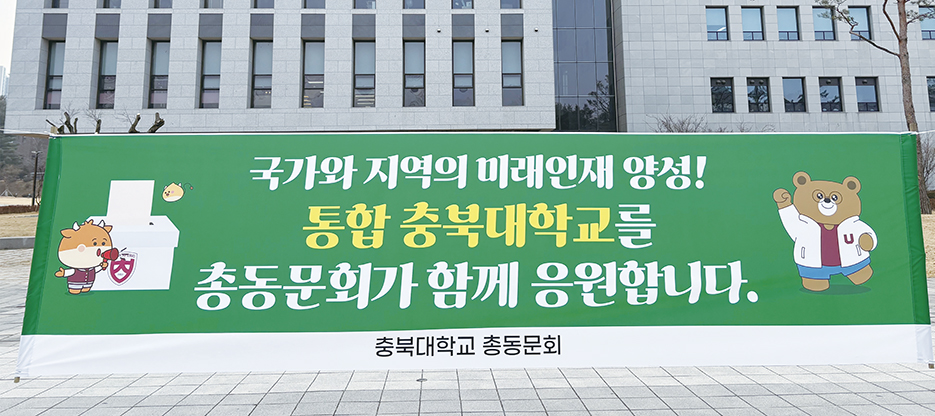
▲ Development of future talent in the nation and region! United Alumni Association will support the integrated CBNU together. -CBNU United Alumni Association-
CBNU and Korea National University of Transportation (KNUT) have revived talks on a planned university integration. The integration push, which began after the government launched the 30 Glocal Institutions Initiative launched in 2023, was suspended once after a CBNU community vote rejected the plan in Dec. 2025. Resignation plans announced by President Koh Chang-seop, who had led the process, did not end the initiative. Further discussions between the two universities produced a revised set of terms, and a re-vote at CBNU has moved the integration procedure forward again.
The integration has been promoted as part of broader efforts to address the declining college-age population and mounting pressures on regional universities, while strengthening the competitiveness of national universities, securing financial support, and reorganizing education and research systems. Specific proposals have also heightened sensitivity on campus, including possible adjustments in academic operations, division of roles across campuses, institutional identity, and governance arrangements after integration.
Why the Integration Was Pursued
Both universities have cited shrinking admissions resources driven by demographic decline and the financial and operational burden faced by regional universities. Universities have faced simultaneous demands to maintain enrollment, stabilize finances, and secure education and research capacity, which have elevated the need for more efficient academic administration and differentiated specialization strategies.
The immediate trigger for the integration review was the government’s 30 Glocal Institutions Initiative. The initiative was designed to provide large-scale financial support when universities propose and implement plans for structural reform and competitiveness enhancement. CBNU and KNUT reviewed a joint innovation plan that included integration, submitted relevant materials, and proceeded to discuss detailed agendas such as the integrated university’s name, academic operation directions, the division of functions between the Cheongju and Chungju campuses, and the overall organizational structure.
Issues that Surfaced as Talks Became More Concrete
As discussions progressed, key points of contention included potential overlap adjustment and restructuring of departments ▲possible department relocation linked to campus role division ▲changes to institutional identity and branding ▲governance structure and authority allocation after integration.
Department adjustment drew heightened sensitivity because it could be tied to quota changes or consolidation. Department relocation was also raised as a possibility if campus role division becomes concrete, prompting concerns about changes to educational conditions and the burden of commuting or relocation. Institutional identity repeatedly appeared in the debate, with opinions split over whether changes in name and system could affect belonging and perceptions of diploma value.
Governance questions emerged as another major fault line. Topics included how to select the first president of the integrated university, configure the central administrative structure, and allocate representation in major decision-making bodies. While the two institutions were equal parties during negotiations, a single unified institution would require a different decision-making design after integration, which kept governance arrangements at the center of debate.
Why the Process Stalled Once
A vote on whether to proceed with integration was held at CBNU on Dec. 3 to 4, 2025, among faculty, staff, and students. The proposal failed because none of the three groups reached a majority in favor. Support was reportedly stronger at KNUT, while rejection at CBNU halted the overall effort.
Opposition at the time centered on disagreements over governance design and the terms of the agreement. The method for selecting the first president and the post-integration decision-making structure were repeatedly cited as contentious issues. Concerns were also raised about how to reflect the relative size of the two universities and how to distribute authority. Critics further argued that the standards for revising agreed terms was set too high, which could make institutional improvements difficult if problems arise later. Concerns also included the possibility of department relocation and overlap adjustment, with opponents linking those issues to academic autonomy and institutional identity.
Following the vote results, President Koh, who had led the integration effort, said he intended to resign. CBNU is currently operating under an acting president system.
Re-Discussion and Re-Vote
The integration debate did not end. CBNU continued its reviews after the rejection through discussions involving representative campus bodies, including the Faculty Council, Staff Council, Student Council, and the Council of Deans. The reviews examined reasons for the failed vote and revisited the direction of the integration process.
Several revisions were presented during the renewed discussions. Proposals included holding a joint process to select the first president after integration and adopting a voting method that does not apply weighting between the two universities. Additional explanations were also discussed regarding the division of roles between the Cheongju and Chungju campuses and how departments would be operated, with an emphasis on addressing the issues that had fueled concern among university members.
The revised discussion points and overall progress were shared with members of CBNU through an integration-related briefing session held on Feb. 11. The session took place shortly before the re-vote and proceeded through an outline of the process, an explanation of the revised terms, and a question-and-answer session.
A re-vote on whether to proceed with submitting an integration application was held online on Feb. 12 to 13, 2026, among faculty, staff, and students at CBNU. Approval requirements were met after faculty recorded 69.02% support and staff recorded 59.67% support. Students recorded 37.21% support and 62.79% opposition, meaning opposition is higher among students, while the faculty and staff made majority support.
The eligible electorate totaled 796 faculty members, 649 staff members, and 16,542 students. Participation reached 707 faculty members (88.82%), 605 staff members (93.22%), and 9,896 students (59.82%).
The first vote was held on Dec.3 to 4, 2025 and recorded opposition shares of 55.8% among faculty, 52.8% among staff, and 63.2% among students, placing the integration initiative in jeopardy. Subsequent revisions to the selection method for the first president and adjustments to certain agreement clauses preceded the shift that led to passage in the re-vote.
After the re-vote passed at CBNU, the two universities signed an integration agreement on Feb.19 and submitted an integration application to the Ministry of Education’s University Merger and Review Committee.. A decision could be made as early as March.
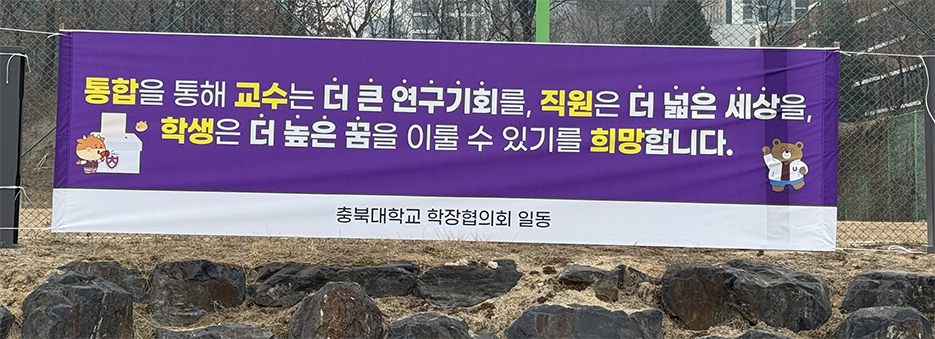
▲ Through integration, we hope that professors can achieve greater research opportunities, employees can achieve a wider world, and students can achieve higher dreams. -CBNU Council of Deans-
How the President Selection Method Is Designed
The first president of the integrated university is set to be chosen through a joint election based on the principle of one-person, one-vote. The joint integration promotion delegations reportedly reached the agreement on Feb. 9, deciding not to apply voting weights between the two universities and choosing a direct election in which faculty, staff, and students participate.
The President Recommendation Committee is planned to be formed with equal numbers from both universities, aiming to maintain balance during the candidate nomination process.
The revised agreement was formalized after it was approved through the CBNU community vote held on Feb.12 to 13. The Ministry of Education approval would halt the ongoing process to select presidential candidates at CBNU, followed by a new election process aligned with the integrated university framework.
Campus Opinions Remain Divided
The passage of the re-vote did not end the debate on campus. Students and staff, in particular, voiced views that acknowledge the need for integration to some extent while also arguing that information on operational details and future changes has not been shared sufficiently.
One student who expressed concerns said the idea of a horizontal integration feels burdensome given differences in admissions outcomes and perceived institutional image between the two universities. The student added that uncertainty remains because it has not been clearly explained how degree value and institutional identity might be changed after integration.
A favorable view was also expressed. Another student said integration between national universities may be necessary in the long term under demographic decline affecting regional universities. The student said positive changes could follow, including facility investment and expanded education programs linked to the government initiative. The student also said the university must explain not only potential advantages but also expected problems in order to gain broader understanding from members.
Staff members also voiced cautious views. A staff member said integration could help in administrative efficiency and finances, while adding that guidance remains insufficient on what changes would occur in day-to-day operations. Another staff member said the process has felt fast, leaving limited time for members to fully understand and express opinions.
Calls for more information and continuing communication have accompanied both support for integration and concern about insufficient disclosure. While the re-vote result has accelerated the process again, requests persist for explanations that members can concretely understand.
Post-Approval Procedures Remain
While the re-vote at CBNU has restarted the integration procedure, opposition voices have continued, including within KNUT and among parts of the Chungju community. The Ministry of Education approval would trigger follow-up steps such as amendments to bylaws, organizational restructuring, adjustments to academic systems, finalization of campus role division, reorganization of department operations, preparation of budget and financial management plans, and the election of a president.
The integration process is expected to move into an implementation phase that includes coordination of remaining issues and more detailed explanations and communication with university members and local communities.
By Choi Yun-ji | cjyyuyu@chungbuk.ac.kr
By Kim Si-won | 2021020022@chungbuk.ac.kr


 Quick News