

 최종편집 : 2026.10.19 월 17:57
 All
 Feature


 Kang Yeo-min

A Small Society Beyond Campus
Today, for university students, part-time jobs have gone beyond earning pocket money and become essential for covering educational and living expenses. As inflation continues to rise, students face a growing burden of covering tuition and living expenses on their own. For university students, part-time work serves as both a way to earn wages and an opportunity to gain experience beyond the campus environment.
However, young adults’ first experiences in the working world are not always warm and fair. Depending on the business owners and managers they meet, the workplace can become an intimidating space they dread entering every day, or a place where they gain confidence through respect and consideration. A CBT reporter met with working students who have worked or are currently working in various industries to hear about their difficult experiences and what made them want to remain in their jobs.
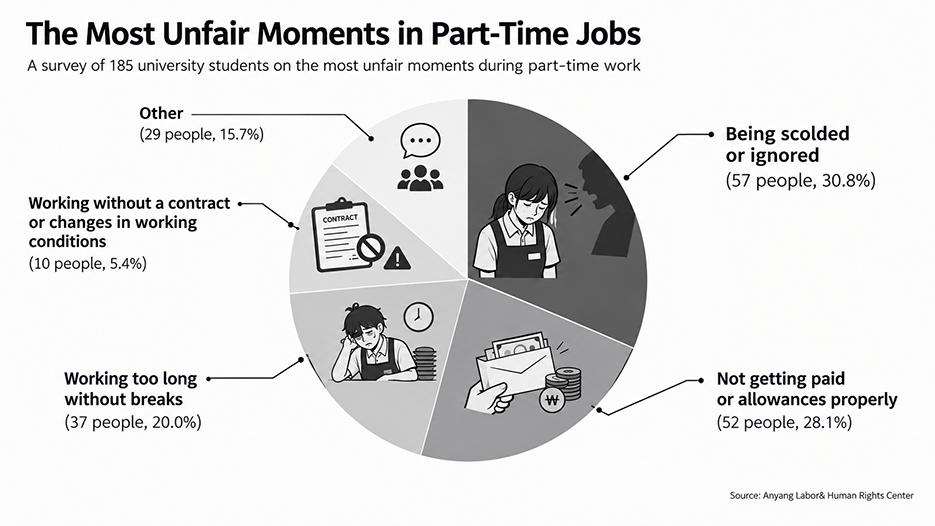
“The Boss Made Me Act like the Villain”… Unfair Demands Beyond Job Duties
When managers or business owners abuse their authority to demand tasks outside the scope of employee’s duties, the boundary between professional and personal life in the workplace becomes blurred. Working students with little work experience often face it difficult to refuse, even when they feel the demands are unfair.
Student A (Dept. of Information & Statistics, 24), a student at CBNU who worked for 10 months as a teaching assistant and instructor at a private academy, shared an experience where she was drawn into a conflict between the owner and another staff member. To protect her own image, the owner shifted the responsibility for resolving the conflict onto student A, who had the least work experience. “The owner had a conflict with another employee at the academy, but fearing that stepping in directly would damage her image, she asked me to call that employee and tell them to apologize to her.” What flustered student A even more was the timing of the request—well past 11 p.m., far outside her working hours.
“Why Are You So Slow?”… The Discouragement caused by in Public Reprimands
There are also instances where students are publicly reprimanded simply for being unfamiliar with tasks or working at a slower pace. Especially in fast-paced workplaces like fast-food restaurants or franchise cafes, workers can easily feel pressured to work quickly. Student B (Dept. of Chemistry, 24), who has been working at a large franchise fast-food restaurant for a year and a half, was publicly criticized while adjusting after transferring from another branch. Student B said, “It was during the period when I had just transferred and was adapting to the new store. One day, the manager called my name loudly in the center of the store. Then he publicly berated me, saying, ‘How long have you been working here? Why are you moving so slowly?’” Recalling that moment, Student B said, “I was so embarrassed and bewildered.” She added, “For a while after that incident, every time I went to work, I became hyper-aware of others and felt intimidated while working.”
Wage Cuts and ‘Work-Splitting’… Wage Issues Reported by Students
Wage compliance remains a complex issue where legal standards often clash with economic realities on the ground. Student B highlighted stark differences in wage execution depending on workplace size, noting that small local businesses often face challenges fully incorporating statutory allowances.
Student B shared, “When comparing notes with friends, the working conditions vary significantly depending on the business structure. At smaller independent shops, employers often reduce hourly wages by 20 to 30 % during initial periods under the pretext of training, or pay below the minimum wage to offset initial productivity gaps.”
Student B also pointed to short-hour employment arrangements—capped at 14.5 hours per week—as a widespread practice, saying “Hiring staff under 15 hours a week to avoid statutory weekly holiday allowances has become a standard approach for many small business owners. When students ask for their legal rights, it often leads to conflict, as employers feel pressured by fixed labor costs.”
Rather than attributing these conflicts strictly to individual employer ethics, these cases reveal a structural dilemma. These cases show a bigger problem: How to protect student workers’ rights while understanding the financial difficulties of small businesses. To solve this problem, we need ways to protect workers’ rights while considering the challenges that small businesses face.
Cases of Recognizing Preparation Time as Legal Working Hours
On the other hand, some cases highlight how fair recognition of working hours positively impacts working students. In the interviews, workplaces that provided wage recognition—such as including pre-class preparation as paid working hours—were identified as positive examples of labor compliance.
Student A shared her experience as an academy instructor, where the employer formally recorded the time spent preparing lecture materials and solving problems prior to class as official working hours. The hourly wage for preparation was calculated at the same rate as actual teaching time. Rather than relying on informal goodwill, the employer applied a standard that accurately valued the required labor process.
Student A recalled, “The employer officially recognized the time I spent preparing materials and solving problems before class as working hours, calculating my pay at the exact same hourly rate as teaching. Beyond merely logging hours, he respected my original problem-solving methods, which allowed me to recognize my work as legitimate labor.” This clear boundary between labor and compensation built mutual professional trust.
This case suggests that improving student labor conditions requires going beyond individual employers’ personal goodwill or leniency. Instead, the focus should be on establishing clear, institutional standards that ensure fair compensation for all actual labor performed.
Turning Mistakes into Learning Opportunities and Protecting Employees
Student C (Dept. of Chemistry, 24) said “I gained confidence in my first cafe job thanks to my manager’s response. It was my very first time working at a cafe, so I mixed up recipes and had difficulty using the Point Of Sale (POS) machine, making frequent mistakes. However, the owner did not get angry or criticize me harshly; instead, he pointed out what went wrong and gave me time to correct my mistakes myself.”
Student B shared an experience of being yelled at due to a misunderstanding with a customer during a weekend peak time. “Because it was the weekend, the store was extremely busy, and a minor misunderstanding occurred while communicating with a customer. A customer pointed a finger at my face and suddenly yelled at me. Having little work experience, I was very shocked and hurt.” However, a manager who watched this immediately stepped in to settle the situation and called Student B aside. The manager said, “It is definitely not your fault, so do not take it to heart too much. You are doing great.” Student B added, “Just knowing that someone was there to protect me in the workplace gave me immense relief.”
Clear Workplace Communication, Work Schedules Accommodating Studies
Clear workplace communication and flexible scheduling are also important features for a good workplace. Student B pointed to systematic communication and schedule adjustment methods that respect workers’ situations as the reasons he was able to continue working for a year and a half.
“In the past, announcements were delivered through group KakaoTalk chats or BAND, which sometimes hurt colleagues’ feelings or led to public criticism of specific workers. However, with the recent adoption of a part-time worker app, we now have a clear way to check notices and tasks, which helps separates professional and personal life.” In particular, the system that allows workers to select their available working hours directly helps them balance work and studies. “Even during exam periods or department events, I could coordinate my schedule, allowing me to continue working long-term for over a year.”
Student C also stated that the employer’s consideration of university students’ situations is the core of a good working environment, adding “During midterm or final exam periods, employers’ flexibility in adjusting schedules while saying ‘studies come first’ acts as the most practical and desperate oasis for student workers.”
A Good Workplace Begins with Basic Standards and Respect
The criteria for a good workplace identified by students were not unreasonable. They included meeting legal standards, separating work from personal matters, and respecting workers as individuals.
Today, working students balance their studies with part-time work. They do not expect special treatment, but simply fair pay for their work, respect as individuals, and time to learn from their mistakes.
Providing proper training, working together to solve problems, and taking responsibility for one’s work are important for creating a pruductive and respectful workplace. When these basic principles are respected, the workplace can become a space where young adults and business owners grow together through mutual respect.
By Kang Yeo-min
yeomin@chungbuk.ac.kr


 Quick News