

 최종편집 : 2026.10.19 월 17:57
 All
 Society & Global


 Jeong Ha-yeon

A proposed amendment to the Enforcement Decree of the Mental Health and Welfare Act has sparked debate over the scope of practice for public mental health counseling personnel. The Ministry of Health and Welfare (MOHW) aims to include public psychological counseling and disaster psychological support services under the common duties of four categories of mental health professionals. The Ministry states that the measure is intended to reflect existing field practices in the law. Conversely, organizations such as the Korean Clinical Psychological Association (KCPA) argue that because education and training programs vary significantly by specialty, standardization criteria to verify counseling competency must be established first. The core issue lies in balancing service accessibility with professional standards.
What Is Changing?
On Sept. 7, MOHW issued a legislative pre-announcement of proposed amendments to the Enforcement Decree of the Mental Health and Welfare Act, with public comments open through Oct. 19. The proposed amendment adds “the performance of psychological counseling and disaster psychological support projects provided by the state or local governments” to the shared duties of mental health professionals. Mental health professionals are qualified personnel meeting specific credentials and training in mental health. They are divided into four categories: Mental Health Clinical Psychologists, Mental Health Nurses, Mental Health Social Workers, and Mental Health Occupational Therapists. The amendment applies exclusively to these certified mental health professionals and does not extend counseling duties to general nurses, social workers, or occupational therapists. Furthermore, by framing these duties around state and local government projects, the amendment remains distinct from policies establishing qualification standards for nongovernmental psychological counseling.
Current work boundaries are specified in Article 12, paragraph 2, and Table 2 of the Enforcement Decree of the Mental Health and Welfare Act. Mental health clinical psychologists handle psychological evaluations, psychoeducation, individual and family counseling, and psychological stabilization. Mental health nurses conduct observation, data collection, nursing activities, and health promotion planning. Mental health social workers manage social service surveys, social welfare service consultation, and guidance, while mental health occupational therapists oversee occupational assessments, therapy, and related education. Shared duties already include operating mental rehabilitation facilities, supporting rehabilitation training, establishing individual support plans, conducting research, and providing mental health education. The conflict centers on whether the revision merely clarifies existing practices or expands responsibilities without sufficient verification of professional competency across disciplines.
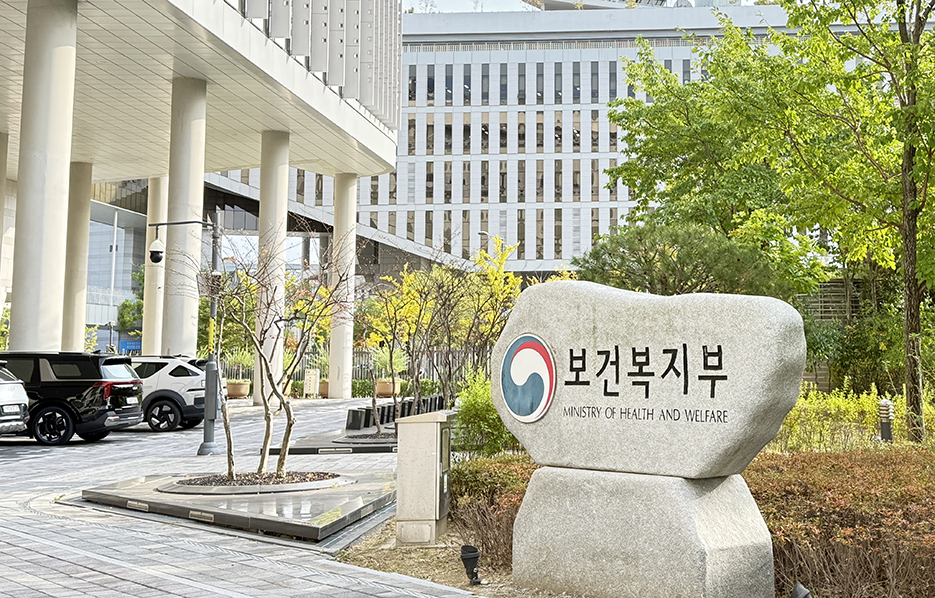
▲ The Front of MOHW.
Proponents: Providing Legal Grounds for Existing Fieldwork
The debate stems from growing demand for public psychological counseling. Launched on July 1, 2024, the “National Mind Investment Support Program” offers eight sessions of conversation-based counseling for individuals experiencing emotional distress. To meet the initial demand, certified private counselors were included as service providers. As public demand grew, calls emerged to formalize the role of counseling personnel in regulations.
According to the ministry’s explanatory notes (Notice No.2026-473), the shared duties were added to reflect real-world contributions to national support and disaster psychological support projects. Supporters in social welfare, nursing, and occupational therapy expect legal authorization to facilitate project management and ensure rapid deployment during large-scale crises. Proponents emphasize service accessibility and the stability of service provision. To ensure timely assistance, they argue that the system must utilize professionals across fields who already perform counseling duties at local mental health welfare centers. Closing the gap between law and practice is seen as essential to meeting growing mental health needs.
Opponents: Training Varies Despite Shared Qualifications
In a Q&A document published in Sept. 2026, the KCPA argued that training content and practical competencies must be verified before defining counseling as a shared duty. The association emphasized that holding a qualification does not automatically guarantee counseling proficiency. The document noted that clinical psychology training focuses on assessment, case formulation, psychotherapy, and clinical supervision. In contrast, other disciplines prioritize nursing care, social service coordination, and functional recovery. While counseling elements exist in other fields, general counseling experience within a specific discipline does not necessarily indicate competence in specialized psychological counseling. The KCPA stated that its goal is not to exclude other fields or monopolize counseling, but to advocate for interdisciplinary collaboration grounded in specialized expertise. Anyone intervening in training psychological crises or psychopathology must demonstrate corresponding practical training and competence.
155 Psychology Students at CBNU Issue Joint Statement: “Protecting Future Counselee”
Opposition has spread across academia, professional associations, and trainees. At CBNU, 155 undergraduate and graduate psychology students issued a joint statement and staged a rally on Oct. 7 at 1:10 p.m. Students emphasized that expanding access and maintaining professional rigor are separate matters, noting that the amendment threatens the foundation of psychological education and research. Yoon Dan-bi, a master’s graduate in clinical psychology who moderated the declaration of the state of affairs, stated, “I spent my 20s completing four years of undergraduate study, three years of graduate school, and three years of training. The sole reason we build this expertise is that intervening in someone’s mind is a profound responsibility.” She added that the primary purpose of rigorous training is ensuring counselee safety rather than obtaining a certification.
From Consultation to Verification: Balancing Access and Expertise
Whether public feedback was properly gathered remains another point of contention. While the ministry noted that it consulted an advisory body composed of the heads of the four professional associations, the KCPA countered that holding consultative meetings does not constitute verification of counseling competence. Listening to opinions, the association argues, is distinct from systematically reviewing training standards. In its document “Key Issues and Policy Alternatives Q&A,” the KCPA explained that the MOHW held three consultative meetings in July and Aug., and that the association submitted a revised proposal in its final opinion on Aug. 21. However, the association criticized the ministry for proceeding with legistrative pre-announcement without fully addressing supervision, quality control, or training guidelines. The issue highlights the tension between expanding public access to mental health services and verifying practitioner expertise. Beyond formalizing field duties, clearer guidelines are needed regarding training, supervision, and competency evaluation. Discussions must focus on ensuring that citizens receive safe, timely, and professional psychological support.
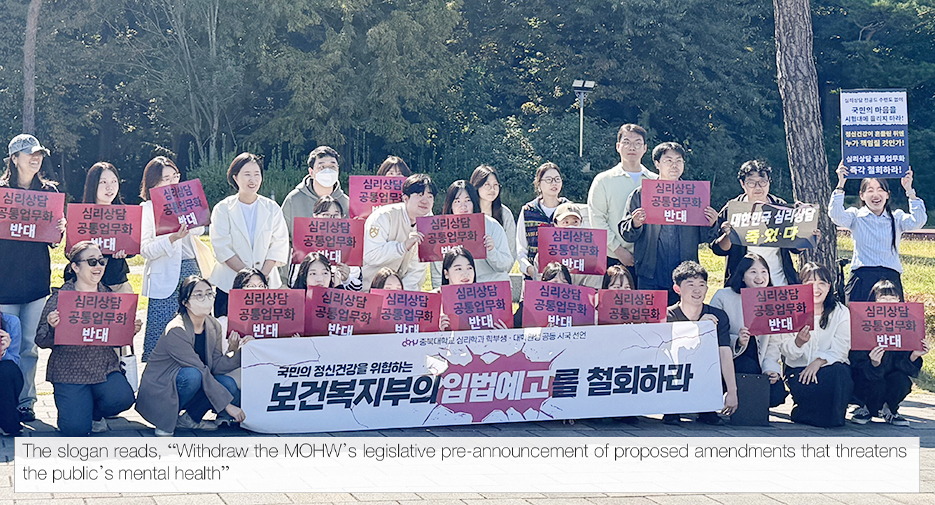
▲ Psychology students from CBNU issue a joint declaration at the main gate on Oct. 7.
By Jeong Ha-yeon
hayeon0330@chungbuk.ac.kr


 Quick News